Wednesday, August 31, 2022

02 Paintings, Middle East Artists, Nasser Ovissi's Thorses, with Footnotes, #47

NASSER OVISSI (IRAN, B. 1934)
POLO PLAYER AND EAGLE
Oil on canvas
140 x 75 cm.
Private collection

NASSER OVISSI (IRAN, B.1934)
TWO SEATED HORSES
Acrylic, gold paint and gold leaf on canvas, c. 1972/73
84 x 65.5 cm
Private collection

Nasser Ovissi is an American-Iranian painter whose work is characterized by stylized figures of Arabic women and horses. Set amidst geometric patterns and decorative elements, his figures seem to merge into and out of the space behind them. “My work is dedicated to the beauty of life and I hope those who experience my work will walk away with an experience of beauty.” Born in Tehran, Iran in 1934, Ovissi studied Law and Political Sciences at the University of Tehran before studying fine art at Beaux Fine Art in Rome. The artist has achieved numerous awards and honors, including being exhibited at the 1959 Paris Biennial and a Grand Prize at the 1962 Biennale of Fine Arts of Tehran. Ovissi lives and works in Reston, VA. His works are included in the collections of the Contemporary Art Museum in Madrid and the National Art Gallery of Greece in Athens. More on Nasser Ovissi


Please visit my other blogs: Art Collector, Mythology, Marine Art, Portrait of a Lady, The Orientalist, Art of the Nude and The Canals of Venice, Middle East Artists, 365 Saints and 365 Days, also visit my Boards on Pinterest

Images are copyright of their respective owners, assignees or others. Some Images may be subject to copyright

I don't own any of these images - credit is always given when due unless it is unknown to me. if I post your images without your permission, please tell me.

I do not sell art, art prints, framed posters or reproductions. Ads are shown only to compensate the hosting expenses.

If you enjoyed this post, please share with friends and family.

Thank you for visiting my blog and also for liking its posts and pages.

Please note that the content of this post primarily consists of articles available from Wikipedia or other free sources online.


Saturday, August 27, 2022

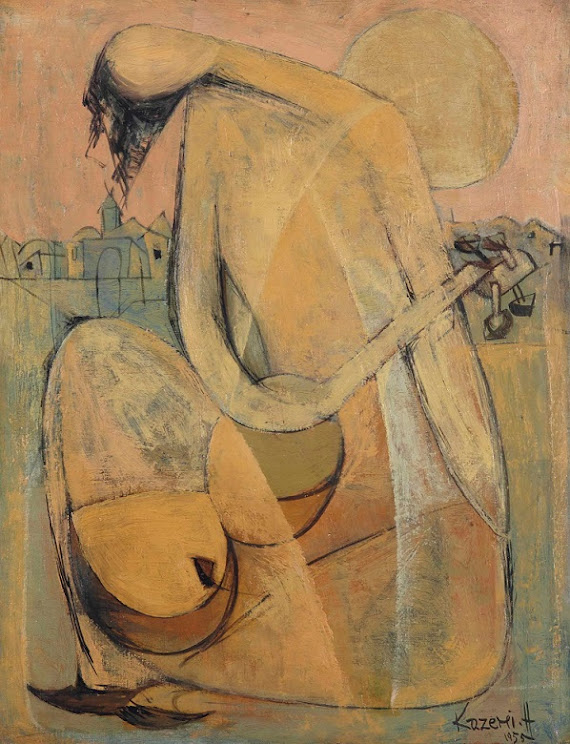
01 Painting, Middle East Artists, Hossein Kazemi's Tar Player, with Footnotes, #46

Hossein Kazemi (Iranian, 1924-1996)
Tar Player, c. 1955
Oil on canvas
25 5/8 x 19¾in. (65 x 50cm.)
Private collection

A Tar is an Iranian long-necked string instrument, waisted lute family instrument, used by many cultures. This is in accordance with a practice common in Persian-speaking areas of distinguishing lutes on the basis of the number of strings originally employed. More on a Tar

A leading and pioneer Iranian Modern artist, Hossein Kazemi moved away from the academic style of Kamal Al-Molk following his studies at the Ecole des Beaux-Arts in Paris. The present work, a charming portrait from Kazemi's beginnings, reveals his experimentation with Cubism and his fascination by Western Modernist painting while hinting at his Persian heritage, notably with the traditional Iranian instrument held by the figure and the abstracted background. A rare and charming composition from his celebrated Cubist period, this work was gifted to a prominent and well-respected artist of his generation. Kazemi himself loved it so much, that he started another version of the same painting to keep in his personal collection, a work that unfortunately was left unfinished when the artist passed away in 1996. More on this painting

One of the most prominent Iranian artists, Hossein Kazemi began his career in 1940s by focusing on figurative art. Portraits of popular figures such as Sadegh Hedayat drew attention. However, Kazemi's artistic style began evolving as he started experimenting with Cubism and became fascinated by Western Modernism.

In 1953, Kazemi moved to Paris and entered the 'Ecole des Beaux Arts'. Aware of his Iranian heritage, Kazemi was eager to search for a style that would incorporate Persian elements and also be modern. As the artist's work became more abstract, his inspiration by certain elements from Persian art remained evident. His interest in stylized forms from Ancient Persia, miniature paintings, ceramic tiles and manuscript illuminations are reflected on his canvases. Kazemi arrived at his desired composition and form, with its harmonious colours: a wide range of blues and violets, variations of semi-abstract objects such as stones and flowers and thick layers of pigment, which became his signature style. More on Hossein Kazemi


Please visit my other blogs: Art Collector, Mythology, Marine Art, Portrait of a Lady, The Orientalist, Art of the Nude and The Canals of Venice, Middle East Artists, 365 Saints and 365 Days, also visit my Boards on Pinterest

Images are copyright of their respective owners, assignees or others. Some Images may be subject to copyright

I don't own any of these images - credit is always given when due unless it is unknown to me. if I post your images without your permission, please tell me.

I do not sell art, art prints, framed posters or reproductions. Ads are shown only to compensate the hosting expenses.

If you enjoyed this post, please share with friends and family.

Thank you for visiting my blog and also for liking its posts and pages.

Please note that the content of this post primarily consists of articles available from Wikipedia or other free sources online.


Sunday, July 24, 2022

01 Painting, Middle East Artists, Ghasem Hajizadeh's Yesterday-Today, with Footnotes, #45

Ghasem Hajizadeh (Iranian, b. 1947)
Yesterday-Today, c. 1975
Oil in canvas
53 1/8 X 78 3/8in. (135 x 199cm.)
Private collection

Yesterday-Today is an enigmatic work that is representative of the artist's signature style. One of the most sought after artists within Tehran's high society since the late 1960s and early 1970s, Hajizadeh is known for his compositions that bring together his memories of the past with his inspirations from the contemporary popular culture.

Throughout his career, Hajizadeh portrayed a great number of famous and popular characters - from Qajar princesses to Princess Stéphanie de Monaco, from Mossadegh to the Iranian beloved female poet Forough Farrokhzad or the popular singer and performer Mahvash. In the present work, the figures are not recognisable icons, but they are metaphors for the man-female relationships throughout history. Inspired by Pop CD covers, kitsch advertisements and urban illustrations, Hajizadeh's works unveil his playfulness and sense of irony while they reveal his nostalgic remembrance of the past. More on this painting


Ghasem Hajizadeh (orn April 1, 1947; Lahijan, Iran) is an Iranian–French painter and a pioneering Pop art figure in contemporary Iranian art.

Hajizadeh was born in 1947 in Lahijan, north of Iran. He received his diploma in arts from Tehran High School of Fine Arts in 1967 and soon after started his art career. During his early years, Hajizadeh's works were mostly abstract. However, he changed his style and concentrated on figurative art. During the 1960s and early 1970s, he was encouraged him to pursue pop art movement, which was thriving in the United States. In 1972, Hajizadeh participated in the first art exhibition, held by Iran–America Society.

While he held several solo and group exhibitions inside and outside post-revolution Iran, after establishment of the Islamic Republic, he could no longer run any public exhibitions for his work. In 1986, he fled to France, living and working in Paris. During his career in arts, his works have been shown in galleries and museum around the world. More on Ghasem Hajizadeh


Please visit my other blogs: Art Collector, Mythology, Marine Art, Portrait of a Lady, The Orientalist, Art of the Nude and The Canals of Venice, Middle East Artists, 365 Saints and 365 Days, also visit my Boards on Pinterest

Images are copyright of their respective owners, assignees or others. Some Images may be subject to copyright

I don't own any of these images - credit is always given when due unless it is unknown to me. if I post your images without your permission, please tell me.

I do not sell art, art prints, framed posters or reproductions. Ads are shown only to compensate the hosting expenses.

If you enjoyed this post, please share with friends and family.

Thank you for visiting my blog and also for liking its posts and pages.

Please note that the content of this post primarily consists of articles available from Wikipedia or other free sources online.


Wednesday, July 13, 2022

01 Painting, Middle East Artists, Ghazi Saudi, with Footnotes, #44

Ghazi Saudi (Iraq)
Untitled, c. 1960
Oil on canvas, framed
77 x 60cm (30 5/16 x 23 5/8in).
Private collection

"The city of Ghazi al Saudi , today's Baghdad, is the actual place implanted in a time that goes back some eight hundred years. Al Wasiti's illustrations of Maqamat al Hariri have been a constant inspiration for him, not only in his smaller canvases and ceramics, but also in his large frescoes, where he employs the old Arab gold, blue and red with black outlines in the representation of cit-scapes translated into a modern idiom" More on The city of Ghazi al Saudi

Born in Baghdad in 1935, Al-Saudi studied at the Institute of Fine Arts in Baghdad in 1953. Later, he trained in Rome specialising in murals and frescoes and returned to Baghdad in the early-mid 1960s where he joined the faculty at the same Institute. In 1965, he held his first solo exhibition after returning from Italy. The exhibition was at Al-Wasiti Gallery in Baghdad; a private gallery space founded by pioneer Iraqi architects Mohamed Makiya and Saeed Ali Mathloum.

He is best known for several remarkable murals in Baghdad, such as the notable entrance of Az-Zawraa’ Park and the Baghdadi Museum. Al-Saudi murals have a distinctive style informed by the Iraqi modern art movement of the 1950s yet stand out stylistically and technically as unique examples of public art. More on Ghazi Saudi


Please visit my other blogs: Art Collector, Mythology, Marine Art, Portrait of a Lady, The Orientalist, Art of the Nude and The Canals of Venice, Middle East Artists, 365 Saints and 365 Days, also visit my Boards on Pinterest

Images are copyright of their respective owners, assignees or others. Some Images may be subject to copyright

I don't own any of these images - credit is always given when due unless it is unknown to me. if I post your images without your permission, please tell me.

I do not sell art, art prints, framed posters or reproductions. Ads are shown only to compensate the hosting expenses.

If you enjoyed this post, please share with friends and family.

Thank you for visiting my blog and also for liking its posts and pages.

Please note that the content of this post primarily consists of articles available from Wikipedia or other free sources online.

Sunday, July 10, 2022

01 Painting, Middle East Artists, Boutros al-Maari's Antar and Abla, with Footnotes, #59

Boutros al-Maari, (SYRIA, BORN 1968)
Antar and Abla, c. 2019
Acrylic on canvas
130 x 100cm (51 3/16 x 39 3/8in).
Private collection

Antarah ibn Shaddad al-Absi (525–608), also known as Antar, was a pre-Islamic Arab knight and poet, famous for both his poetry and his adventurous life.  Stories of his heroic exploits have been circulating for centuries and were eventually written down in the eighth century. Set in pagan Arabia known as the jahiliya, "before the time of the prophet", the events in the stories have their roots in the history of the Arabs.

The slave-son of an Arab prince, Antar fell in love with his high-born cousin Abla. He was born into tribe of Abs, one of the many tribes roaming the Arabian desert. His mother was an Ethiopian slave and his father was a prince of the tribe. He grew outside the accepted circle of the society and Antar spent his childhood pasturing the tribe's flock of sheep and goats. On the desert plains he learned to ride skillfully, and practiced throwing his spear until he was better accomplished, stronger and more feared than any other slave. His father also did not recognize him as a son but he excelled and distinguished himself in battle. Antar became his tribe's hero and poet.

The stories recount his heroic struggles to raise himself above the circumstances of his birth to gain his rightful position within his tribe and to become worthy of his beautiful cousin Abla. His poems to her are highly admired and widely quoted in the Arab world. More on Antar and Abla

Born in 1978 in Damascus, Syria, Boutros al-Maari obtained a Ph.D. in Social Anthropology from the École des hautes études en sciences sociales (EHESS) in Paris in 2006, and a degree in Printmaking from the Faculty of Fine Arts, Damascus University, in 1991, where he is currently Professor of Fine Arts. Al-Maari has held several solo exhibitions in Paris and Damascus, and has participated in a large number of group exhibitions in Damascus, Beirut, Alexandria, Hanover and Paris. 

In his paintings, Boutros al-Maari reflects the relationship between time and place, inspired by memories of lived experiences. Utilizing simple, yet strongly expressive characters, he projects his artistic vision by connecting figures from his life in Damascus and Paris. He lives and works in Damascus. More on Boutros al-Maari


Please visit my other blogs: Art Collector, Mythology, Marine Art, Portrait of a Lady, The Orientalist, Art of the Nude and The Canals of Venice, Middle East Artists, 365 Saints, 365 Days, and Biblical Icons, also visit my Boards on Pinterest

Images are copyright of their respective owners, assignees or others. Some Images may be subject to copyright

I don't own any of these images - credit is always given when due unless it is unknown to me. if I post your images without your permission, please tell me.

I do not sell art, art prints, framed posters or reproductions. Ads are shown only to compensate the hosting expenses.

If you enjoyed this post, please share with friends and family.

Thank you for visiting my blog and also for liking its posts and pages.

Please note that the content of this post primarily consists of articles available from Wikipedia or other free sources online.

Monday, July 4, 2022

01 Photograph, Middle East Artists, Tarek Al-Ghoussein's Al-Wihdat Refugee Camp, with Footnotes, #35

Tarek Al-Ghoussein (Palestinian, b. 1962)
Al-Wihdat Refugee Camp #3, c. 1993
Gelatin silver
8-3/8 x 12-1/2 inches (21.3 x 31.8 cm)
Private collection

Tarek Al-Ghoussein was born in Kuwait, his grandparents were Palestinian exiles who were unable to visit their native home. His father, Talat Al-Ghoussein, was a journalist, editor and a diplomat who served as the Kuwait ambassador to the United States in the 1960s. His family moved a lot during his childhood between Kuwait, United States, Morocco and Japan. He received his bachelor's degree in photography from New York University and completed his master's degree in Fine Arts from University of New Mexico. He held several positions during his career, worked as a photojournalist, taught photography at the American University of Sharjah and is currently a professor at New York University branch in Abu Dhabi. More on Tarek al Ghoussain


Please visit my other blogs: Art Collector, Mythology, Marine Art, Portrait of a Lady, The Orientalist, Art of the Nude and The Canals of Venice, Middle East Artists, and 365 Saints, also visit my Boards on Pinterest

Images are copyright of their respective owners, assignees or others. Some Images may be subject to copyright

I don't own any of these images - credit is always given when due unless it is unknown to me. if I post your images without your permission, please tell me.

I do not sell art, art prints, framed posters or reproductions. Ads are shown only to compensate the hosting expenses.

If you enjoyed this post, please share with friends and family.

Thank you for visiting my blog and also for liking its posts and pages.

Please note that the content of this post primarily consists of articles available from Wikipedia or other free sources online.


Thursday, June 30, 2022

01 Painting, Middle East Artists, Jellal Ben Abdallah's LA MUSICIENNE, with Footnotes, #61

Jellal Ben Abdallah, (1921-2017)
LA MUSICIENNE/ THE MUSICIAN GIRL
Mixed technique on paper
86 X 54 CM (33 7/8 X 21 1/4 IN.)
Private collection

Jellal Ben Abdallah, Tunisia (1921 - 2017) enrolled in the École des Beaux-Arts de Tunis but stayed only three weeks. After winning the first prize in painting and receiving a scholarship, he moved to Paris for three months in 1949. In Paris, Ben Abdallah joined the Académie de la Grande Chaumière in Montparnasse district and also traveled to Venice, Florence and Rome. Still, Ben Abdallah is more considered to be a self-taught artist and acquired experiences from his encounters with European or Tunisian professional painters. He progressively entered the Tunisian artistic circles and was a founding member of the École de Tunis under the supervision of Pierre Boucherle in 1949. For a while, Jellal Ben Abdallah was passionate about the Italian Renaissance and primitives, but the initial artist's inspiration was the Tunisian popular culture. He fancied illustrating moments of daily life, particularly with female figures, through very poetic scenes in the style of a miniaturist. His drawings were delicate, and his lines simplified. In parallel, he was commissioned to execute frescoes or decors for many establishments and institutions in France and Tunisia. Jellal Ben Abdallah passed away in 2017 in Sidi Bou Saïd. More on Jellal Ben Abdallah


Please visit my other blogs: Art Collector, Mythology, Marine Art, Portrait of a Lady, The Orientalist, Art of the Nude and The Canals of Venice, Middle East Artists, 365 Saints and 365 Days, also visit my Boards on Pinterest

Images are copyright of their respective owners, assignees or others. Some Images may be subject to copyright

I don't own any of these images - credit is always given when due unless it is unknown to me. if I post your images without your permission, please tell me.

I do not sell art, art prints, framed posters or reproductions. Ads are shown only to compensate the hosting expenses.

If you enjoyed this post, please share with friends and family.

Thank you for visiting my blog and also for liking its posts and pages.

Please note that the content of this post primarily consists of articles available from Wikipedia or other free sources online.

Saturday, June 25, 2022

01 Painting, Middle East Artists, Nasser Ovissi's Rakhsh and the Simorgh, with Footnotes, #60

Nasser Ovissi, (IRAN, BORN 1934)
Rakhsh and the Simorgh, c. 2010
Paint on gold leaf,
70 x 50cm (27 9/16 x 19 11/16in).
Private collection

Rakhsh ("luminous") is the stallion of protagonist Rostam in the Persian national epic, Shahnameh of Ferdowsi.

The color of Rakhsh is described as "rose leaves that have been scattered upon a saffron ground" and it is first noticed by Rostam amongst the herds of horses brought over from Zabulistan and Kabul. In this first encounter Rakhsh is described as a mighty colt with the chest and shoulders of a lion and it appears to have the strength of an elephant. He is highly intelligent and his loyalty is legendary. No one but Rostam ever rides Rakhsh, and Rakhsh recognizes no one but Rostam as his master. Also, he is the only horse ever that Rostam could ride, since his great strength and weight would kill other horses.

Due to divine favor protecting Rostam, Rakhsh lives an unusually long life. Rostam and Rakhsh both die by the treason of Rostam's half-brother, Shaghad. More on Rakhsh and the Simorgh


Nasser Ovissi is an American-Iranian painter whose work is characterized by stylized figures of Arabic women and horses. Set amidst geometric patterns and decorative elements, his figures seem to merge into and out of the space behind them. “My work is dedicated to the beauty of life and I hope those who experience my work will walk away with an experience of beauty.” Born in Tehran, Iran in 1934, Ovissi studied Law and Political Sciences at the University of Tehran before studying fine art at Beaux Fine Art in Rome. The artist has achieved numerous awards and honors, including being exhibited at the 1959 Paris Biennial and a Grand Prize at the 1962 Biennale of Fine Arts of Tehran. Ovissi lives and works in Reston, VA. His works are included in the collections of the Contemporary Art Museum in Madrid and the National Art Gallery of Greece in Athens. More on Nasser Ovissi


Please visit my other blogs: Art Collector, Mythology, Marine Art, Portrait of a Lady, The Orientalist, Art of the Nude and The Canals of Venice, Middle East Artists, 365 Saints and 365 Days, also visit my Boards on Pinterest

Images are copyright of their respective owners, assignees or others. Some Images may be subject to copyright

I don't own any of these images - credit is always given when due unless it is unknown to me. if I post your images without your permission, please tell me.

I do not sell art, art prints, framed posters or reproductions. Ads are shown only to compensate the hosting expenses.

If you enjoyed this post, please share with friends and family.

Thank you for visiting my blog and also for liking its posts and pages.

Please note that the content of this post primarily consists of articles available from Wikipedia or other free sources online.

Wednesday, June 22, 2022

01 Painting, Middle East Artists, Fahrelnissa Zeid's Metropolis, ith Footnotes, #42

Fahrelnissa Zeid,  (TURKEY, 1900-1991)
Metropolis
Mixed media on paper, circa 1950's
74 x 106cm (29 1/8 x 41 3/4in)
Private collection

Fahrelnissa Zeid (7 January 1901 – 5 September 1991) was a Turkish artist best known for her large-scale abstract paintings with kaleidoscopic patterns. Also using drawings, lithographs, and sculptures, her work blended elements of Islamic and Byzantine art with abstraction and other influences from the West. Zeid was one of the first women to go to art school in Istanbul. She lived in different cities and became part of the avant-garde scenes in Istanbul, pre-war Berlin and post-war Paris. Her work has been exhibited at various institutions in Paris, New York, and London, including the Institute of Contemporary Art in 1954. In the 1970s, she moved to Amman, Jordan, where she established an art school. In 2017, Tate Modern in London organized a major retrospective of the artist and called her "one of the greatest female artists of the 20th century". 

In the 1930s, she married into the Hashemite royal family of Iraq. More on Fahrelnissa Zeid 


Please visit my other blogs: Art Collector, Mythology, Marine Art, Portrait of a Lady, The Orientalist, Art of the Nude and The Canals of Venice, Middle East Artists, 365 Saints and 365 Days, also visit my Boards on Pinterest

Images are copyright of their respective owners, assignees or others. Some Images may be subject to copyright

I don't own any of these images - credit is always given when due unless it is unknown to me. if I post your images without your permission, please tell me.

I do not sell art, art prints, framed posters or reproductions. Ads are shown only to compensate the hosting expenses.

If you enjoyed this post, please share with friends and family.

Thank you for visiting my blog and also for liking its posts and pages.

Please note that the content of this post primarily consists of articles available from Wikipedia or other free sources online.

Saturday, June 18, 2022

01 Painting, Middle East Artists, Louai Kayyali's UNTITLED (LADY), with Footnotes, #61

Louai Kayyali, 1934-1978, SYRIAN
UNTITLED (LADY), c. 1974
Oil on masonite
95 by 95cm.; 37 3/8 by 37 3/8 in.
Private Collection

Louay Kayali, (1934–1978) was a Syrian modern artist. Kayali was born in Aleppo, Syria in 1934 and studied art in the Accademia di Belle Arti after having studied at the Al-Tajhiz School where his work was first exhibited in 1952. He met Syrian artist Wahbi Al-Hariri there and the two would share a friendship for the rest of Kayali's life. Al-Hariri would become his mentor as he was for artist Fateh Moudarres that Hariri introduced to Kayali in 1955. Moudarress and Kayali would together represent Syrian modern art at the Venice Biennial Fair. He suffered from depression and died in 1978 from burns incurred from his bed catching fire, reportedly from a cigarette. More on Louay Kayali


Please visit my other blogs: Art Collector, Mythology, Marine Art, Portrait of a Lady, The Orientalist, Art of the Nude and The Canals of Venice, Middle East Artists, 365 Saints and 365 Days, also visit my Boards on Pinterest

Images are copyright of their respective owners, assignees or others. Some Images may be subject to copyright

I don't own any of these images - credit is always given when due unless it is unknown to me. if I post your images without your permission, please tell me.

I do not sell art, art prints, framed posters or reproductions. Ads are shown only to compensate the hosting expenses.

If you enjoyed this post, please share with friends and family.

Thank you for visiting my blog and also for liking its posts and pages.

Please note that the content of this post primarily consists of articles available from Wikipedia or other free sources online.


Tuesday, June 14, 2022

02 Paintings, Middle East Artists, Ayman Baalbaki's Anonymous, with Footnotes, #56

Ayman Baalbaki (LEBANON, BORN 1975)
Anonymous
Acrylic on carton laid on canvas
70 x 50cm (27 9/16 x 19 11/16in).
Private collection

Ayman Baalbaki (born in 1975 in Adaisseh, Lebanon) is a Lebanese painter. He studied at the Lebanese University and at the École nationale supérieure des arts décoratifs in Paris. His large-scale expressionist portraits of fighters made him one of the most popular young Arab artists. 

Born the year the civil war started in Lebanon, Ayman Baalbaki draws most of his inspiration from these events. His paintings often depict destroyed buildings, sometimes occupied by refugees who were forced to leave their homes during the combats. After the 2006 Lebanon War he drew series of scattered structures related to the demolitions consecutive to the bombings of Beirut's southern suburbs.

Ayman Baalbaki's most popular series depict warriors bearing veils or casks. These portraits of anonymous figures became a symbol of the endless conflicts in the Middle East. These paintings have been exhibited worldwide, including the 2011 Venice Biennale. In 2012, Baalbaki participated in Hoods for Heritage, a project consisting of 16 Porsche 911 hoods transformed into art works by artists and designer and auctioned on benefit of the Beirut National Museum. More on Ayman Baalbaki


Ayman Baalbaki (LEBANON, BORN 1975)
Anonymous II
Acrylic on carton laid on canvas
70 x 50cm (27 9/16 x 19 11/16in).
Private collection


Please visit my other blogs: Art Collector, Mythology, Marine Art, Portrait of a Lady, The Orientalist, Art of the Nude and The Canals of Venice, Middle East Artists, 365 Saints and 365 Days, also visit my Boards on Pinterest

Images are copyright of their respective owners, assignees or others. Some Images may be subject to copyright

I don't own any of these images - credit is always given when due unless it is unknown to me. if I post your images without your permission, please tell me.

I do not sell art, art prints, framed posters or reproductions. Ads are shown only to compensate the hosting expenses.

If you enjoyed this post, please share with friends and family.

Thank you for visiting my blog and also for liking its posts and pages.

Please note that the content of this post primarily consists of articles available from Wikipedia or other free sources online.

Saturday, June 4, 2022

01 Painting, Middle East Artists, Lorna Selim's Baghdadiyat, with Footnotes, #57

Lorna Selim, (IRAQ, BORN 1928)
Baghdadiyat
Oil on canvas
31 x 26cm (12 3/16 x 10 1/4in).
Private collection

Lorna Selim received a scholarship to study at the Slade School of Fine Arts, London, where she received a diploma in painting and design in 1948. The following year she received an Art Teachers' Diploma (ATD) from the London University Institute of Education. From 1949–50 she taught art at the Tapton House Grammar School, Chesterfield, England. In the UK, she met Jewad Selim and they married in 1950. Returning to Baghdad, Lorna Selim became a member of the Baghdad Modern Art Group, Art Friends Society, and Society of Iraqi Plastic Artists. During the 1950s, she exhibited her work with the Baghdad Modern Art Group and the Pioneers Group. She was an art teacher at Ta'ssisiya School, Baghdad, in 1951, and participated in the Iraqi Pavilion Design for the International Fair held in Damascus in 1954. Along with Mohamed Ghani Hikmet, she supervised the completion of Jewad Selim's Monument of Freedom after his sudden death in 1961.

She taught drawing and painting at the Girls College in 1961, and the architecture department of the Engineering College, Baghdad University, in 1965. She lives and works in Abergavenny, Wales. Her work is held in collections including Mathaf: Arab Museum of Modern Art, Doha. More on Lorna Selim


Please visit my other blogs: Art Collector, Mythology, Marine Art, Portrait of a Lady, The Orientalist, Art of the Nude and The Canals of Venice, Middle East Artists, 365 Saints and 365 Days, also visit my Boards on Pinterest

Images are copyright of their respective owners, assignees or others. Some Images may be subject to copyright

I don't own any of these images - credit is always given when due unless it is unknown to me. if I post your images without your permission, please tell me.

I do not sell art, art prints, framed posters or reproductions. Ads are shown only to compensate the hosting expenses.

If you enjoyed this post, please share with friends and family.

Thank you for visiting my blog and also for liking its posts and pages.

Please note that the content of this post primarily consists of articles available from Wikipedia or other free sources online.


Sunday, May 29, 2022

01 Painting, Middle East Artists, Akram Shukri, with Footnotes, #53

Akram Shukri (Iraq, 1910-1986)
Untitled, c. 1950
Oil on board
56 x 46cm (22 1/16 x 18 1/8in)
Private collection

Akram Shukri is considered one of the most important artists in the development of the Iraqi modern art movement, and although primarily an architect he was the founding member of the Society of Artists and Art Lovers in 1941. This group included important Iraqi artists such as Jawad Selim, Hafiz Droubi and Faik Hassan. Numerous members of this society went on to found other important artist groups; Faik Hassan was the leader of La Societe Primitive which later became known as The Pioneers, and Hafiz Droubi formed a group known as The Baghdad Group of Modern Art. More on Akram Shukri


Please visit my other blogs: Art Collector, Mythology, Marine Art, Portrait of a Lady, The Orientalist, Art of the Nude and The Canals of Venice, Middle East Artists, 365 Saints and 365 Days, also visit my Boards on Pinterest

Images are copyright of their respective owners, assignees or others. Some Images may be subject to copyright

I don't own any of these images - credit is always given when due unless it is unknown to me. if I post your images without your permission, please tell me.

I do not sell art, art prints, framed posters or reproductions. Ads are shown only to compensate the hosting expenses.

If you enjoyed this post, please share with friends and family.

Thank you for visiting my blog and also for liking its posts and pages.

Please note that the content of this post primarily consists of articles available from Wikipedia or other free sources online.

Saturday, May 28, 2022

01 Painting, Middle East Artists, Farid Aouad's Homo Flux with Footnotes, #53

Farid Aouad (Lebanese, 1924-1982) 
Homo Flux, c. early 1970
Oil on canvas 
16 3/8 x 51in. (194 x 129.5cm.)
Private collection

The painting depicts a group of an undefined number of men and women standing at a bar. Expressing an overriding sense of solitude, this scene of lonely strangers at the bar is the artist's way to convey his own feeling of loneliness. Tormented by his memories of Beirut, his inability to be integrated into Parisian society and his extreme poverty, Aouad was in some ways a hermit, having never married and spent time locked up in his studio far away from socialising. The painting of these crowds is two-fold; firstly to express his own solitude while attempting to be social and secondly to stay warm from the harsh French winters as these cafés and bars would offer him refuge from his own poverty. More on this painting

Born in South Lebanon in 1924, Farid Aouad lived in Paris most of his life. Aouad is best known for paintings that express solitude. He used scenes of lonely strangers in bars and cafés. Moreover, his attachment to the familiarity between the streets of old Beirut and Paris are a recurring emotional fixture in his work.

In all the scenes he painted, his acute observation and ability to capture the life of the moment, mixed with his free yet mature graphic style of painting, were the key elements of his success. Aouad became a rare witness of artistic boldness in his generation and showed his art at numerous exhibitions in Lebanon, France, Germany and Italy. Unfortunately, his work was never fully appreciated during his lifetime and he lived out his last years in ill health and poverty.

In a 1977 letter, Aouad wrote: “I produced very little this year: always the same challenge with painting, looking for something that is still missing.”

In 1979, he wrote: “It is cold, windy, and rainy. It is not easy to work. The tourists are hiding the fishermen and their cases, but I always try to find more evident perspectives.” More on Farid Aouad


Please visit my other blogs: Art Collector, Mythology, Marine Art, Portrait of a Lady, The Orientalist, Art of the Nude and The Canals of Venice, Middle East Artists, 365 Saints and 365 Days, also visit my Boards on Pinterest

Images are copyright of their respective owners, assignees or others. Some Images may be subject to copyright

I don't own any of these images - credit is always given when due unless it is unknown to me. if I post your images without your permission, please tell me.

I do not sell art, art prints, framed posters or reproductions. Ads are shown only to compensate the hosting expenses.

If you enjoyed this post, please share with friends and family.

Thank you for visiting my blog and also for liking its posts and pages.

Please note that the content of this post primarily consists of articles available from Wikipedia or other free sources online.