Tuesday, January 31, 2023

01 Painting, Middle East Artists, THE ART OF WAR, Louai Kayyali's Then What, with Footnotes #66

Louai Kayyali, 1934-1978, SYRIAN
Then What, c. 1965
190 x 172 cm
Oil on wood, 1965
Private collection

In Kayyali’s work eleven figures (seven women, two boys and one man) are crowded together as though walking in unison. With most of their gazes turned away from the viewer, they are lost in the suggested horror of their surroundings as several peer up at an invisible, looming force. In the center of the canvas is a man whose features are distorted as the artist has rendered his face with quick brush marks and few details. 

Louai Kayyali, 1934-1978, SYRIAN
Then What, c. 1965
Detail

Hunched over and overpowered by an incomprehensible weight, he seems to carry the burden of mankind. His arched back, angular chin and hidden face resemble Masaccio’s Adam in “The Expulsion from Paradise” (1427). Behind him stands a female figure in profile, her head stretched far into the sky, as she beckons the heavens for reprieve and reflects the inescapable posture of a body that is overrun by grief. Kayyali has painted her face in a near identical rendering of Eve in the above-mentioned fresco, as he simply rearranged the central figures of Masaccio’s composition. More on this painting

Louay Kayali, (1934–1978) was a Syrian modern artist. Kayali was born in Aleppo, Syria in 1934 and studied art in the Accademia di Belle Arti after having studied at the Al-Tajhiz School where his work was first exhibited in 1952. He met Syrian artist Wahbi Al-Hariri there and the two would share a friendship for the rest of Kayali's life. Al-Hariri would become his mentor as he was for artist Fateh Moudarres that Hariri introduced to Kayali in 1955. Moudarress and Kayali would together represent Syrian modern art at the Venice Biennial Fair. He suffered from depression and died in 1978 from burns incurred from his bed catching fire, reportedly from a cigarette. More on Louay Kayali


Please visit my other blogs: Art Collector, Mythology, Marine Art, Portrait of a Lady, The Orientalist, Art of the Nude and The Canals of Venice, Middle East Artists, 365 Saints and 365 Days, also visit my Boards on Pinterest

Images are copyright of their respective owners, assignees or others. Some Images may be subject to copyright

I don't own any of these images - credit is always given when due unless it is unknown to me. if I post your images without your permission, please tell me.

I do not sell art, art prints, framed posters or reproductions. Ads are shown only to compensate the hosting expenses.

If you enjoyed this post, please share with friends and family.

Thank you for visiting my blog and also for liking its posts and pages.

Please note that the content of this post primarily consists of articles available from Wikipedia or other free sources online.


Wednesday, January 18, 2023

02 Paintings, Middle East Artists, Louay Kayyali's Maaloula, with Footnotes, #65

Louay Kayyali (Syrian, 1934-1978)
Maaloula, c. 1963
Oil on canvas
29¼ x 36in. (75 x 94.5cm.)
Private collection

Maaloula is one of the main subjects in Kayyali’s oeuvre; the present work is painted only two years after the artist graduated from the Accademia di Belle Arti and it is one of the finest portrayals of this mountainous Aramaic town. All elements are intricately balanced, orchestrated by his ability in articulating the subtleties of line and perspective of the holy city’s mountain and its sheltering village and soothing skies.

The village of Maaloula is located to the northeast of Damascus and built into the rugged mountainside, with a population of just a few hundred. Maaloula, from the Aramaic word ma'la meaning "entrance", is the only place where the western dialect of Aramaic, the language of Jesus Christ, is still spoken. It is home to two important monasteries, Mar Sarkis and Mar Taqla. The Mar Sarkis monastery was named after a Roman soldier, executed for his Christian beliefs. The Mar Taqla monastery holds the remains of St. Taqla (Thecla), daughter of one of Seleucid's princes, and pupil of St. Paul. According to legend, in the 1st century AD, soldiers pursued St.Taqla and her father because of her Christian faith. She came upon a mountain and after praying, the mountain split to reveal a gorge like that of Petra, through which she escaped. The town is named after this entrance to the mountain. Naturally there are many variations of this story among the residents of Maaloula, which adds to its historical and spiritual significance. More on Maaloula

Louai Kayyali
Maloula, c. 1965
Oil on canvas
76 x 48 cm.; 30 by 18 7/8 in.
Private collection

Louay Kayali, (1934–1978) was a Syrian modern artist. Kayali was born in Aleppo, Syria in 1934 and studied art in the Accademia di Belle Arti after having studied at the Al-Tajhiz School where his work was first exhibited in 1952. He met Syrian artist Wahbi Al-Hariri there and the two would share a friendship for the rest of Kayali's life. Al-Hariri would become his mentor as he was for artist Fateh Moudarres that Hariri introduced to Kayali in 1955. Moudarress and Kayali would together represent Syrian modern art at the Venice Biennial Fair. He suffered from depression and died in 1978 from burns incurred from his bed catching fire, reportedly from a cigarette. More on Louay Kayali


Please visit my other blogs: Art Collector, Mythology, Marine Art, Portrait of a Lady, The Orientalist, Art of the Nude and The Canals of Venice, Middle East Artists, 365 Saints and 365 Days, also visit my Boards on Pinterest

Images are copyright of their respective owners, assignees or others. Some Images may be subject to copyright

I don't own any of these images - credit is always given when due unless it is unknown to me. if I post your images without your permission, please tell me.

I do not sell art, art prints, framed posters or reproductions. Ads are shown only to compensate the hosting expenses.

If you enjoyed this post, please share with friends and family.

Thank you for visiting my blog and also for liking its posts and pages.

Please note that the content of this post primarily consists of articles available from Wikipedia or other free sources online.


Saturday, January 14, 2023

01 Painting, Middle East Artists, Louai Kayyali's The match Seller, with Footnotes, #64

Louai Kayyali, 1934-1978, SYRIAN
The match Seller, c. 1974
Oil on masonite
90 by 80cm
Private Collection

Louay Kayali, (1934–1978) was a Syrian modern artist. Kayali was born in Aleppo, Syria in 1934 and studied art in the Accademia di Belle Arti after having studied at the Al-Tajhiz School where his work was first exhibited in 1952. He met Syrian artist Wahbi Al-Hariri there and the two would share a friendship for the rest of Kayali's life. Al-Hariri would become his mentor as he was for artist Fateh Moudarres that Hariri introduced to Kayali in 1955. Moudarress and Kayali would together represent Syrian modern art at the Venice Biennial Fair. He suffered from depression and died in 1978 from burns incurred from his bed catching fire, reportedly from a cigarette. More on Louay Kayali


Please visit my other blogs: Art Collector, Mythology, Marine Art, Portrait of a Lady, The Orientalist, Art of the Nude and The Canals of Venice, Middle East Artists, 365 Saints and 365 Days, also visit my Boards on Pinterest

Images are copyright of their respective owners, assignees or others. Some Images may be subject to copyright

I don't own any of these images - credit is always given when due unless it is unknown to me. if I post your images without your permission, please tell me.

I do not sell art, art prints, framed posters or reproductions. Ads are shown only to compensate the hosting expenses.

If you enjoyed this post, please share with friends and family.

Thank you for visiting my blog and also for liking its posts and pages.

Please note that the content of this post primarily consists of articles available from Wikipedia or other free sources online.


Saturday, January 7, 2023

01 Painting, Middle East Artists, Easam Darawshi's Expressive Portrait #2, with Footnotes, #63

Easam Darawshi, Palestinian, b. 1984
Expressive Portrait #2, c. 2021
Acrylic on canvas
78 7/10 × 41 3/10 in, 200 × 105 cm

Essam Darawshi was born in Nazareth in 1984. He studied Physiotherapy at the Faculty of Medicine at Genoa University, Italy. In 2010, Easam enrolled in the Academy of Arts at the University of Genoa where he began his journey as an artist, driven by his passion, focusing on the Arabic Calligraphy as a form of contemporary art.

In 2013, Easam went back to his hometown where he started working on figurative and expressionist artworks influenced by graffiti, murals, and street art. His portraits do not capture the external figure of a subject, they rather serve as a portal for a journey of self-exploration and an attempt to experience a variety of forms and search for identity. Easam believes that facial expressions cannot be captured in a single moment or form hence his canvases reflect the complexity of emotions surrounding identity; one's relationship to the surrounding environment and contradicting feelings of belonging. Easam’s work is deeply influenced by social conflict and psychological paradoxes of present-day life. He uses different techniques and applies a variety of mixed media and materials. More on Essam Darawshi


Please visit my other blogs: Art Collector, Mythology, Marine Art, Portrait of a Lady, The Orientalist, Art of the Nude and The Canals of Venice, Middle East Artists, 365 Saints and 365 Days, also visit my Boards on Pinterest

Images are copyright of their respective owners, assignees or others. Some Images may be subject to copyright

I don't own any of these images - credit is always given when due unless it is unknown to me. if I post your images without your permission, please tell me.

I do not sell art, art prints, framed posters or reproductions. Ads are shown only to compensate the hosting expenses.

If you enjoyed this post, please share with friends and family.

Thank you for visiting my blog and also for liking its posts and pages.

Please note that the content of this post primarily consists of articles available from Wikipedia or other free sources online.


Wednesday, January 4, 2023

02 Paintings, Middle East Artists, Rafat Asad's Haifa, with Footnotes, #62

Rafat Asad, Palestinian, b. 1974
Haifa II, c. 2018
Acrylic on canvas
23 3/5 × 23 3/5 in, 60 × 60 cm

Haifa is the third-largest city in Israel—after Jerusalem and Tel Aviv—with a population of 285,316 in 2019. The city of Haifa forms part of the Haifa metropolitan area, the third-most populous metropolitan area in Israel. 

Over the millennia, the Haifa area has changed hands: being conquered and ruled by the Assyrians, Babylonians, Canaanites, Israelites, Phoenicians, Persians, Hasmoneans, Romans, Byzantines, Arabs, Crusaders, Ottomans, and the British. More on Haifa

Rafat Asad, Palestinian, b. 1974
Haifa I, c. 2018
Acrylic on canvas
23 3/5 × 23 3/5 in, 60 × 60 cm

Rafat Asad was born in Nablus in 1974 and was awarded a Bachelors degree in fine art from Al Najah University in 1998. Altough he is a multi-disciplinary artist- producing sound and light installations, video and performances- Asad describes himself as a painter first and foremost. Starting as an abstract painter, his work has evolved to focus on Palestinian Landscape. This had made his recent work unique, brilliant and somewhat “reductionist” in style.

He has participated in group exhibitions in Palestine, Europe, Japan, the US and the Arab world. Asad’s works have been shown in five Solo Exhibitions at a variety of venues including Nablus (1999), Ramallah (2006) And London (2006). More on Rafat Asad


Please visit my other blogs: Art Collector, Mythology, Marine Art, Portrait of a Lady, The Orientalist, Art of the Nude and The Canals of Venice, Middle East Artists, 365 Saints and 365 Days, also visit my Boards on Pinterest

Images are copyright of their respective owners, assignees or others. Some Images may be subject to copyright

I don't own any of these images - credit is always given when due unless it is unknown to me. if I post your images without your permission, please tell me.

I do not sell art, art prints, framed posters or reproductions. Ads are shown only to compensate the hosting expenses.

If you enjoyed this post, please share with friends and family.

Thank you for visiting my blog and also for liking its posts and pages.

Please note that the content of this post primarily consists of articles available from Wikipedia or other free sources online.


Wednesday, December 14, 2022

01 Painting, Middle East Artists, Safwan Dahoul's UNTITLED with Footnotes, #58


Safwan Dahoul, B. 1961, SYRIAN
UNTITLED, c. 1992
Oil and gold leaf on wood 
25 by 20cm.; 9 7/8 by 7 7/8 in
Private collection

Safwan Dahoul was born in 1961 in Hama, Syria, Dahoul was initially trained by leading modernists at the Faculty of Fine Arts, University of Damascus before travelling to Belgium, where he earned a doctorate from the Higher Institute of Plastic Arts in Mons. Upon returning to Syria, he began teaching at the Faculty of Fine Arts and was a prominent member of the Damascus art scene. In the span of a decade, Dahoul nurtured a new generation of artists as an active mentor whose evolving aesthetic often ignited new directions in painting. Given the trajectory and status of his painting style, Dahoul’s career is regarded as a crucial link between modern and contemporary Arab art. More on Safwan Dahoul


Please visit my other blogs: Art Collector, Mythology, Marine Art, Portrait of a Lady, The Orientalist, Art of the Nude and The Canals of Venice, Middle East Artists, 365 Saints and 365 Days, also visit my Boards on Pinterest

Images are copyright of their respective owners, assignees or others. Some Images may be subject to copyright

I don't own any of these images - credit is always given when due unless it is unknown to me. if I post your images without your permission, please tell me.

I do not sell art, art prints, framed posters or reproductions. Ads are shown only to compensate the hosting expenses.

If you enjoyed this post, please share with friends and family.

Thank you for visiting my blog and also for liking its posts and pages.

Please note that the content of this post primarily consists of articles available from Wikipedia or other free sources online.


Monday, December 5, 2022

01 Painting, Middle East Artists, Hussein Bikar's THE LANDLORD with Footnotes, #57


Hussein Bikar, 1912 - 2002, EGYPTIAN
THE LANDLORD, c. 1984
Oil on paper 
46 by 27cm.; 18 1/8 by 10 1/2 in
Private collection

Hussein Amin Bicar (2 January 1913 in Alexandria – 16 November 2003) was one of Egypt’s most prominent artists of the 20th century, after graduating from the Cairo higher school of fine arts in 1934, he spent more than 60 years of his life teaching art at schools and universities and then through the press, he is credited for initiating a style of journalistic art that elevated illustrating for news papers to a level close to that of the fine art, he is known for his simple and clear style reflecting the influence of Pharaonic art with its harmony, serenity and mystic. Bicar’s journalistic contributions go beyond illustrations to include art criticism and narrative poetry. Being the first Egyptian artist to illustrate Arabic children’s books, Bicar has played a major role in establishing and promoting this field.

Furthermore, his portraits and oil paintings depicting graceful Egyptian peasants, Nubian scenes, Alexandria and Pharaonic themes as well as his elegant, gracious nature has earned him great recognition and honors. In the words of late journalist Mustafa Amin:"he is not a single artist, he is a master of several arts…he is a painter, photographer, poet, musician and philosopher".

He was of Turkish Cypriot extraction and a member of the BahĆ”'Ć­ Faith. More on Hussein Bikar


Please visit my other blogs: Art Collector, Mythology, Marine Art, Portrait of a Lady, The Orientalist, Art of the Nude and The Canals of Venice, Middle East Artists, 365 Saints and 365 Days, also visit my Boards on Pinterest

Images are copyright of their respective owners, assignees or others. Some Images may be subject to copyright

I don't own any of these images - credit is always given when due unless it is unknown to me. if I post your images without your permission, please tell me.

I do not sell art, art prints, framed posters or reproductions. Ads are shown only to compensate the hosting expenses.

If you enjoyed this post, please share with friends and family.

Thank you for visiting my blog and also for liking its posts and pages.

Please note that the content of this post primarily consists of articles available from Wikipedia or other free sources online.


Thursday, November 24, 2022

01 Painting, Middle East Artists, Shakir Hassan Al-Said's Untitled (Town), with Footnotes, #55

 Shakir Hassan Al-Said, 1925-2004, IRAQI
Untitled (Town), c. 1951
Watercolour and pencil on paper
24 by 20cm.; 9 1/2 by 7 7/8 in.
Private collection

Shakir Hassan Al Said (1925–2004), an Iraqi painter, sculptor and writer, is considered one of Iraq's most innovative and influential artists.

Born in Samawa, Al Said lived, worked and died in Bagdad. In 1948 he received a degree in social science from the Higher Institute of Teachers in Baghdad and in 1954 a diploma in painting from the Institute of Fine Arts in Baghdad. He continued his studies at the Ɖcole nationale supĆ©rieure des Beaux-Arts in Paris until 1959. During his stay in Paris, he discovered Western modern art in galleries and Sumerian art at the Louvre. He returned to Baghdad in 1959.

He co-founded in 1951 with Jawad Saleem Jama'et Baghdad lil Fann al-Hadith (Baghdad Modern Art Group), one of the most unusual arts movements in the Middle East in the post–World War II, itwas called Istilham al-turath (Seeking inspiration from tradition), considered as "the basic point of departure, to achieve through modern styles, a cultural vision". He headed the group after the death of Saleem in 1961.

In 1971, he founded Al Bu'd al Wahad (the One-dimension Group)", which promoted the modern calligraphic school in Arab art.

His work is collected by major museums, such as Mathaf: Arab Museum of Modern Art in Doha, the Guggenheim in New York, and Sharjah Art Museum. More on Shakir Hassan Al Said


Please visit my other blogs: Art Collector, Mythology, Marine Art, Portrait of a Lady, The Orientalist, Art of the Nude and The Canals of Venice, Middle East Artists, 365 Saints and 365 Days, also visit my Boards on Pinterest

Images are copyright of their respective owners, assignees or others. Some Images may be subject to copyright

I don't own any of these images - credit is always given when due unless it is unknown to me. if I post your images without your permission, please tell me.

I do not sell art, art prints, framed posters or reproductions. Ads are shown only to compensate the hosting expenses.

If you enjoyed this post, please share with friends and family.

Thank you for visiting my blog and also for liking its posts and pages.

Please note that the content of this post primarily consists of articles available from Wikipedia or other free sources online.


Saturday, November 5, 2022

01 Painting, Middle East Artists, Abdelaziz Gorgi's CHKOBA PLAYERS; EVE OF RAMADAN, with Footnotes, #52

Abdelaziz Gorgi, 1928-2008
JOUEURS DE CHKOBA; VEILLƉE DU RAMADAN (CHKOBA PLAYERS; EVE OF RAMADAN), circa 1960-1969
Acrylic, gold leaf, ink and pen on paper
76 by 55cm.; 29 7/8 by 21 3/4 in.
Private collection

The chkobba is a card game drawn from the scopa and brought to Tunisia by Italian migrants.

It is played with traditional cards . The game is between two players or two teams of two players most often but it is possible, although infrequent, to play three or four independent players. 

Depending on the regions, provinces and even villages, the rules of the game and the counting of points vary. More on The chkobba

Abdelaziz Gorgi's oeuvre is a testament to a strong attachment to Tunisia, both in its form and practice.  As one of the founders and last president of the Ecole de Tunis, of whom he remained an active practicing artist alongside Jallal Ben Abdallah and Hedi Turki, Gorgi's paintings and tapestries are colourful, repeatedly featuring tokens such as 'chechias', the traditional Tunisian headgear or Chkoba, the traditional Tunisian card game, which both act to symbolize his personal background. Gorgi was also very active in encouraging the arts within his community, designing the first Tunisian postage stamp in 1956 and establishing the Tunis School of painting which he presided over until 1983. In 2000 his efforts were repaid when the Tunisian ministry of Culture announced that the country to be celebrating a ‘Gorgi Year’ of culture. More on Abdelaziz Gorgi


Please visit my other blogs: Art Collector, Mythology, Marine Art, Portrait of a Lady, The Orientalist, Art of the Nude and The Canals of Venice, Middle East Artists, 365 Saints and 365 Days, also visit my Boards on Pinterest

Images are copyright of their respective owners, assignees or others. Some Images may be subject to copyright

I don't own any of these images - credit is always given when due unless it is unknown to me. if I post your images without your permission, please tell me.

I do not sell art, art prints, framed posters or reproductions. Ads are shown only to compensate the hosting expenses.

If you enjoyed this post, please share with friends and family.

Thank you for visiting my blog and also for liking its posts and pages.

Please note that the content of this post primarily consists of articles available from Wikipedia or other free sources online.

Wednesday, November 2, 2022

01 Painting, Middle East Artists, Adham Wanly's Le monastère copte, désert de Mariut/ The Coptic Monastery, Mariut Desert, with Footnotes, #56

Adham Wanly, 1908-1959, EGYPTIAN
Le monastère copte, désert de Mariut/ The Coptic Monastery, Mariut Desert, c. 1953
Oil on paper
28,5 x 33,5 cm
Private collection

The late Pope Kyrillos VI established this Coptic Orthodox monastery in 1959 in commemoration of Saint Mina (Menas), his patron saint, in an isolated desert area very close to the archaeological site and historical city of Abu Mena in Mariut, near Alexandria, Egypt.

Abu Mena is a UNESCO World Heritage Site, and was once an important Christian pilgrimage site during the 4th to 7th cent. A.D. Numerous little clay bottles (ampullae), on which Saint Mina's name and picture are engraved, were discovered by archeologists in diverse countries around the world, such as Heidelberg, Germany; Milan, Italy; Dalmatia, Croatia; Marseille, France; Dengla, Sudan; and Jerusalem. These pottery ampullae (small holy water and oil flasks brought from pilgrimage places as a souvenir, and mass-produced in Early Byzantine times) come from Abu Mena, near Alexandria in Egypt.

Countless miracles have happened and continue to happen until this day there through the intercessions of Saint Mina the Martyr, Pope Kyrillos VI and the late Abba Mina Ava-Mina (late abbot of the new monastery), whose relics (all three) are preserved in the monastery. More on the Coptic Monastery, Mariut Desert

Adham Wanly (1908 in Alexandria, Egypt – 1959) was a painter who learnt in the atelier of the Italian Otorino Becchi 1932, then set up his own atelier with his brother Seif Wanly (above), and participated in many local and international exhibition specially Venice, SĆ£o Paulo (Brasil), Alexandria Biennale.

The Museum of Modern Art in Alexandria displays many of his paintings. The artist is mostly famous for recording the life of the theater and circus. He specialized in the ballet and opera that is featured in the Cairo Opera House and the Theatre Mohamed Ali in Alexandria. The paintings render the stage lights and movements of the people involved and he is able to express the light and agility in various ways. He had a talent in caricature in which he used in mockery of himself and the people of his time. There is now a museum in his memory. More on Adham Wanly


Please visit my other blogs: Art Collector, Mythology, Marine Art, Portrait of a Lady, The Orientalist, Art of the Nude and The Canals of Venice, Middle East Artists, 365 Saints and 365 Days, also visit my Boards on Pinterest

Images are copyright of their respective owners, assignees or others. Some Images may be subject to copyright

I don't own any of these images - credit is always given when due unless it is unknown to me. if I post your images without your permission, please tell me.

I do not sell art, art prints, framed posters or reproductions. Ads are shown only to compensate the hosting expenses.

If you enjoyed this post, please share with friends and family.

Thank you for visiting my blog and also for liking its posts and pages.

Please note that the content of this post primarily consists of articles available from Wikipedia or other free sources online.


Sunday, October 30, 2022

01 Painting, Middle East Artists, Ibrahim El Dessouki's The Seventh Day, with Footnotes, #51

Ibrahim El Dessouki, Egyptian, b. 1969
The Seventh Day
Oil and oil bars on canvas
98 2/5 × 220 9/10 in, 250 × 561 cm
Private collection

El Dessouki’s triptych of seven majestic, goddess-like women are incarnations of the Egyptian goddess of motherhood, Hathor, in her human, as opposed to bovine form. The painting derives its name from Egyptian tradition, inherited from ancient times, ‘El Sebou’ or ‘The Seventh Day’. The ritual is a seven-day celebration upon the birth of a child; the seventh day is when the child is believed to gain their hearing. The goddess appears in her seven iterations until the final day, upon which she whispers the baby’s faith. The pure-white of their garments highlights their dark features and olive skin to produce a striking image of a woman, captured candidly in the midst of various tasks, who epitomises Eastern ideals of beauty. More on this painting

Ibrahim El Dessouki (b. 1969, Cairo, Egypt) lives and works in Cairo as a painter of a highly condensed style in portraiture as well as in still life painting and landscape. His unique elaborate and highly meticulous treatment of shades & his refined textures that echo his feelings through an extraordinary & notable use of paint kneaded carefully to result in simultaneously dreamy & epic tones of color. Not to mention his immense sized shapes of women who pose at times to inspire awe and bewilderment showing off in the meantime details and mutations of degrees-of dimness, shades and light, to evoke the sense of tenderness and delicacy out of so many thick layers of rich and varied tints of paint which make the painting so vital and poetic.

Dessouki paints animals, still nature, landscape & women all in a soft, incredible & divine contemporary style. He is famous for his paintings of women; some of those paintings express his nostalgia for the women who strolled in his neighborhood when he was a child with their ample bodies hardly covered with a graceful shawl. His paintings of women are simple yet rich with grace and softness; his style is as pleasing to the eye and elegant as his subject matters.

Dessouki participated in exhibitions in Egypt and abroad. In 2003, he was part of the Panorama of 20th Century Egyptian Art in the Bibliotheca Alexandrina in Alexandria. In 2006 & 2008, he was an invited artist to the 10th and 11th Cairo International Biennale. More on Ibrahim El Dessouki


Please visit my other blogs: Art Collector, Mythology, Marine Art, Portrait of a Lady, The Orientalist, Art of the Nude and The Canals of Venice, Middle East Artists, 365 Saints and 365 Days, also visit my Boards on Pinterest

Images are copyright of their respective owners, assignees or others. Some Images may be subject to copyright

I don't own any of these images - credit is always given when due unless it is unknown to me. if I post your images without your permission, please tell me.

I do not sell art, art prints, framed posters or reproductions. Ads are shown only to compensate the hosting expenses.

If you enjoyed this post, please share with friends and family.

Thank you for visiting my blog and also for liking its posts and pages.

Please note that the content of this post primarily consists of articles available from Wikipedia or other free sources online.


Thursday, October 13, 2022

01 Painting, Middle East Artists, Ibrahim El Dessouki's Doors and False Doors 5,, with Footnotes, #50

Ibrahim El Dessouki, Egyptian, b. 1969
Doors and False Doors 5, c. 2021
Oil on canvas
72 4/5 × 47 1/5 in, 185 × 120 cm
Private collection

“False doors”, also known as “Ka doors”, as they allowed the Ka (an element of the “soul”) to pass through them, were common in the mortuary temples and tombs of ancient Egypt from around the Third Dynasty and temples of the New Kingdom. The false door was thought to be a threshold between the world of mortals and the world of deities and spirits. The deity or the deceased could interact with the world of the living either by passing through the door or receiving offerings though it. As a result it was not uncommon to find false doors depicted on the sides of coffins as well as on the cabinets of “shawabti”.

From the middle of the Fifth Dynasty, the decorations often included torus moulding (convex moulding resembling a semicircle in cross section) and a “cavetto cornice” (a concave bracket around the top of a wall or gate with a cross section that resembles a quarter circle in cross section). It is thought that these decorations represented the plants originally used to build predynastic buildings. Images of the deceased were also fairly common. Usually, the decoration was undertaken in such a manner that the deceased appeared to emerge from the false door itself. More on False doors

Ibrahim El Dessouki’s painting style is defined by his unique treatment of paint, accentuated by his ability to create subtle changes in its texture; his unusual use of negative space; and his deft manipulation of shadow and light. While the artist’s genres encompass portraiture, landscape and still life, El Dessouki’s subject matter is very much Egypt-centric, and captures his own unique and hypnotic perspective of the soul and essence of Egypt. More on this painting

Ibrahim El Dessouki (b. 1969, Cairo, Egypt) lives and works in Cairo as a painter of a highly condensed style in portraiture as well as in still life painting and landscape. His unique elaborate and highly meticulous treatment of shades & his refined textures that echo his feelings through an extraordinary & notable use of paint kneaded carefully to result in simultaneously dreamy & epic tones of color. Not to mention his immense sized shapes of women who pose at times to inspire awe and bewilderment showing off in the meantime details and mutations of degrees-of dimness, shades and light, to evoke the sense of tenderness and delicacy out of so many thick layers of rich and varied tints of paint which make the painting so vital and poetic.

Dessouki paints animals, still nature, landscape & women all in a soft, incredible & divine contemporary style. He is famous for his paintings of women; some of those paintings express his nostalgia for the women who strolled in his neighborhood when he was a child with their ample bodies hardly covered with a graceful shawl. His paintings of women are simple yet rich with grace and softness; his style is as pleasing to the eye and elegant as his subject matters.

Dessouki participated in exhibitions in Egypt and abroad. In 2003, he was part of the Panorama of 20th Century Egyptian Art in the Bibliotheca Alexandrina in Alexandria. In 2006 & 2008, he was an invited artist to the 10th and 11th Cairo International Biennale. More on Ibrahim El Dessouki


Please visit my other blogs: Art Collector, Mythology, Marine Art, Portrait of a Lady, The Orientalist, Art of the Nude and The Canals of Venice, Middle East Artists, 365 Saints and 365 Days, also visit my Boards on Pinterest

Images are copyright of their respective owners, assignees or others. Some Images may be subject to copyright

I don't own any of these images - credit is always given when due unless it is unknown to me. if I post your images without your permission, please tell me.

I do not sell art, art prints, framed posters or reproductions. Ads are shown only to compensate the hosting expenses.

If you enjoyed this post, please share with friends and family.

Thank you for visiting my blog and also for liking its posts and pages.

Please note that the content of this post primarily consists of articles available from Wikipedia or other free sources online.


Monday, October 10, 2022

03 Paintings, Middle East Artists, Paul Guiragossian's Femmes en Conversation, with Footnotes, #49

Paul Guiragossian (Lebanese, 1926-1993)
Femmes en Conversation (Women in Conversation), c. 1970
Oil on canvas
28 3/8 x 39 1/8in. (72 x 99.5cm.)
Private collection

Paul Guiragossian (1926 – November 20, 1993) was an Armenian Lebanese painter. Born to Armenian parents, Paul Guiragossian experienced the consequences of exile from a very tender age. Raised in boarding schools, he grew up away from his mother who had to work to make sure her two sons got an education.

Paul Guiragossian (Lebanese, 1926-1993)
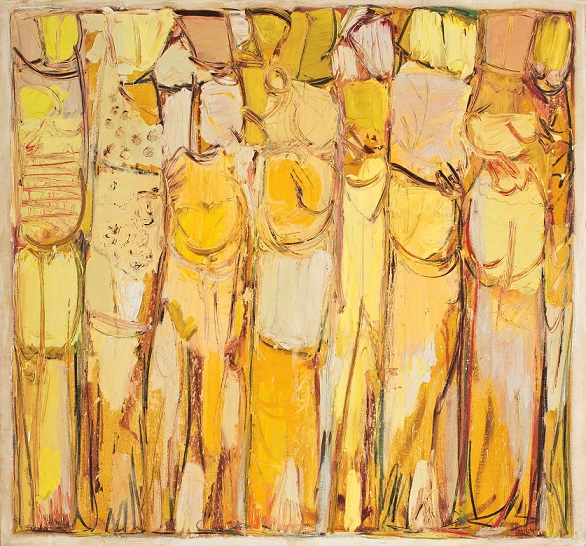
Automne (Autumn), c. 1989
Oil on canvas
53 1/8 x 55 1/8in. (135 x 140cm.)
Private collection

In the 1950s, Guiragossian started teaching art in several Armenian schools and worked as an illustrator. He later started his own business with his brother Antoine, painting cinema banners, posters and drawing illustrations for books. Soon after he was discovered for his art and introduced to his contemporaries after which he began exhibiting his works in Beirut and eventually all over the world.

Paul Guiragossian (Lebanese, 1926-1993)
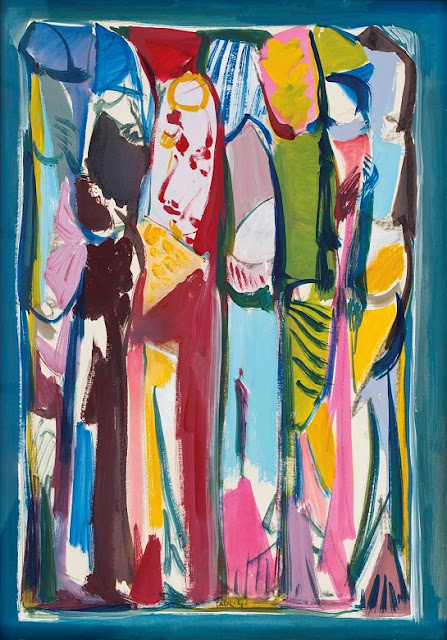
L'Ete (The Summer), c. 1995
signed 'PAUL.G.' (lower centre)
Acrylic on paper
39 3/8 x 27½in. (100 x 70cm.)
Private collection

In 1956, Guiragossian won the first prize in a painting competition, which landed him a scholarship by the Italian government to study at The Academy of Fine Arts of Florence.

In 1962, Guiragossian was granted another scholarship, this time by the French Government, to study and paint in Paris at Les Atelier Des MaƮtres De L'Ecole De Paris.

By the mid 1960s Guiragossian had grown to become one of the most celebrated artists in Lebanon and eventually of the Arab world and even though war broke out in the early 1970s, his attachment to Lebanon grew bigger and his works became more colorful with messages of hope for his people.

In 1989, Guiragossian went to Paris to exhibit his works in La Salle Des Pas Perdus in UNESCO and lived in the city with part of his family until 1991. In that year, he had a solo exhibition at the Institut du Monde Arabe. This exhibition was extended and marked the first solo show at the IMA for any artist. More on Guiragossian


Please visit my other blogs: Art Collector, Mythology, Marine Art, Portrait of a Lady, The Orientalist, Art of the Nude and The Canals of Venice, Middle East Artists, 365 Saints and 365 Days, also visit my Boards on Pinterest

Images are copyright of their respective owners, assignees or others. Some Images may be subject to copyright

I don't own any of these images - credit is always given when due unless it is unknown to me. if I post your images without your permission, please tell me.

I do not sell art, art prints, framed posters or reproductions. Ads are shown only to compensate the hosting expenses.

If you enjoyed this post, please share with friends and family.

Thank you for visiting my blog and also for liking its posts and pages.

Please note that the content of this post primarily consists of articles available from Wikipedia or other free sources online.